
How to resist lifestyle inflation after a pay raise

5 minutes min read
 10 min read
 12 June 2023
Congratulations on entering the workforce! Before you spend your hard-earned money, pause for a moment and consider this: cultivating healthy financial habits can lay the foundation for successful money management.
Whether you’re already budget-savvy and saving for future goals or embracing the YOLO mindset, adopting these financial habits are valuable for everyone. With some guidance and discipline, you can position yourself for long-term financial success.
In this article, we’ll provide you with essential financial tips to make the most of your earnings and start your financial journey on the right track. We have also provided some creative ideas to make healthy financial habits more fun. Hopefully, this will help empower you to make wise financial choices and avoid overspending.
Effective budgeting can help you take control of your finances and achieve your financial goals. With a budget in place, you can accurately track your expenses and identify potential areas where you’re overspending. Do you wonder why you’re left with little money despite eating cai fan (economy rice) every day? It may not be the cost of your meals, but rather those recurring subscriptions for gym or streaming services silently impacting your finances.
So, start tracking all your expenses for a month or two, including bills, lunches, online shopping, online subscriptions, and more. You can utilise budgeting apps or online tools to gamify the process of managing your finances. These apps often provide visualisations or progress trackers to make expense tracking more interactive.
With a clear understanding of where your money is going, you can create a budget that works for you. As your circumstances change, adjust your budget to align with your goals and priorities.
Aim to clear your loans and debts as quickly as you can. The longer you take to pay off debt, the more interest you accumulate. If you took on an education loan for your studies, be proactive in paying these off by setting aside sufficient funds for monthly repayment. If you have the financial means, consider making unscheduled repayments to accelerate the loan repayment process.
If you recently got your first credit card, don’t get overly excited and spend recklessly. Instead, only buy within your limit and pay off your credit card balance on time to avoid accruing high-interest credit card debt. Good credit card repayment habits also improve your credit score and increase your chances of getting better mortgage loans when buying a new house.
Rather than approaching these as a chore, you can set small rewards for achieving financial milestones. By giving yourself occasional treats along the way, you’ll stay motivated and have something to look forward to as you practice healthy financial habits.
Developing short-, mid- and long-term financial goals can help you know what you’re working towards, and help you achieve greater financial security and freedom. Like how you develop your career goals when you first start working, you can consider creating financial goals as well. Mapping out your financial goals can be done through a few simple steps. To achieve your financial goals, creating a clear plan and timeline for each goal is important. Set SMART goals – specific, measurable, achievable, realistic and time-bound goals, and track your progress regularly.
Here are some examples of short-, mid- and long-term goals.
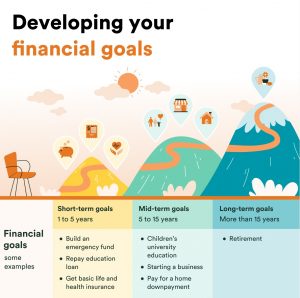
References: MoneySmart1, MoneySense2 , Investopedia3
Think of an emergency fund as a special stash of cash for those “oh no” moments. It’s different from regular savings because it’s precisely there to handle unexpected money emergencies. So, while you might be saving up for fun stuff or big dreams, your emergency fund is like a financial superhero ready to swoop in when life throws you a curve ball. It acts as a shield for unexpected payments as small as a broken laptop to bigger payments such as injuries. In a way, an emergency fund helps you stay on track with your financial goals.
You may be asking, “How much money should I save?” The exact percentage of income you should save for your emergency fund depends on your financial situation and lifestyle. Generally, you should have enough to cover three to six months’ worth of expenses4. However, you can adjust it based on your needs and financial situation.
You can gradually build up your emergency fund by making saving a habit. It’s fine to start small. Afterall, we all have to start somewhere. The key is to start saving early and consistently. To motivate yourself, you can participate in money-saving challenges, where you save a specific amount each week.
As a young, working adult, retirement may seem like a far-off idea. However, starting early can make a huge difference and set you up for long-term success. It’s not just about having a head-start; it’s about shifting your mindset towards wealth building or accumulation.
In Singapore, Central Provident Fund (CPF) is one of the main retirement savings schemes. Apart from CPF, it’s important to start building your retirement nest egg by saving and investing your money. Consider setting aside a portion of your monthly income towards your retirement savings. With discipline and smart investing, you can build a substantial retirement nest egg to help you live comfortably during your golden years.
Assessing your protection needs is another important aspect of financial planning. While you’re young, healthy and feeling invincible, it’s essential to recognise that life’s uncertainties can impact anyone at any age. Even if you’re in good health and have minimal financial responsibilities, it’s still wise to consider getting life insurance. Furthermore, premiums are generally cheaper at this age.
Here are some areas of insurance that you can consider purchasing as a working adult.
While most Singaporeans have government-funded plans such as the MediShield Life, you can also consider getting private health insurance plan. While health insurance provide coverage for hospitalisation and/or medical expenses, certain health conditions may require additional costs.
This is where critical illness insurance could come into play. This type of insurance provides financial support in the event that you are diagnosed with a serious illness or medical condition such as cancer or stroke. Critical illness insurance typically pays out a lump sum amount that can be used to cover medical expenses, replace lost income, or make necessary lifestyle adjustments during your recovery period.
Term insurance usually provide financial protection for your loved ones in the event of your death. This lump sum can help your loved ones cover immediate expenses, such as daily living expenses or outstanding debts, which could include mortgage or university’s tuition fee loan.
Additionally term insurance provides long-term financial stability by replacing the income you would have provided to support your family’s needs and future goals. For example, FWD Term Life Plus insurance ensures that your loved ones’ futures are protected financially for life’s curveballs from as low as S$3/month for S$100,000 term life cover5. We have also just launched our newest feature for FWD Term Life Plus that provides you the flexibility to increase up to 25% of your coverage upon your life’s big event without having to provide evidence of good health.
It’s important to assess your financial obligations to determine the amount of coverage you need. By protecting yourself and your loved ones, you can have greater peace of mind and financial security.
Starting your financial journey after landing your first job is indeed exciting. However, it can also be overwhelming when it comes to managing your finances. By adopting these good financial habits, you can set yourself up for long-term financial success and security.
5 min read


1 https://blog.moneysmart.sg/budgeting/short-medium-long-term-goals/
2 https://www.moneysense.gov.sg/articles/2020/6/setting-financial-goals
3 https://www.investopedia.com/articles/personal-finance/100516/setting-financial-goals/
4 https://blog.seedly.sg/emergency-fund/
5 For a female, non-smoker, aged 18 with sum insured of S$100,000 for a yearly renewable term.
This article contains only general information and does not have any regard to the specific investment objectives, financial situation and the particular needs of any specific person. This shall not constitute as financial advice. You may wish to seek advice from a financial adviser representative for a financial needs analysis before purchasing a policy suitable to meet your needs.
This policy is protected under the Policy Owners’ Protection Scheme which is administered by the Singapore Deposit Insurance Corporation (SDIC). Coverage for your policy is automatic and no further action is required from you. For more information on the types of benefits that are covered under the scheme as well as the limits of coverage, where applicable, please contact your insurer (or name of Scheme member) or visit the GIA/LIA or SDIC web-sites (www.gia.org.sg or www.lia.org.sg or www.sdic.org.sg).
Information presented shall not be distributed, modified, transmitted, reused, reposted, or be used for public or commercial purposes, including the text, images, audio, and video without the consent from FWD Singapore Pte. Ltd. This advertisement has not been reviewed by the Monetary Authority of Singapore. Information is correct as of 29 May 2023.



 6820 8888


 6820 8888